How I Turn An Interview Into Something Useful For The Audience
I have hosted conversations for The Beyond Elevated Show and helped launch and host MortgagePoint’s MP Access Show. The subject matter changed, but the preparation question stayed useful: what should someone understand better when the conversation ends?
A guest can be accomplished and the recording can still leave the audience with very little to use. I want the questions to draw out decisions, examples and the thinking behind them. Here is the five-question planning sheet I would use before pressing record.
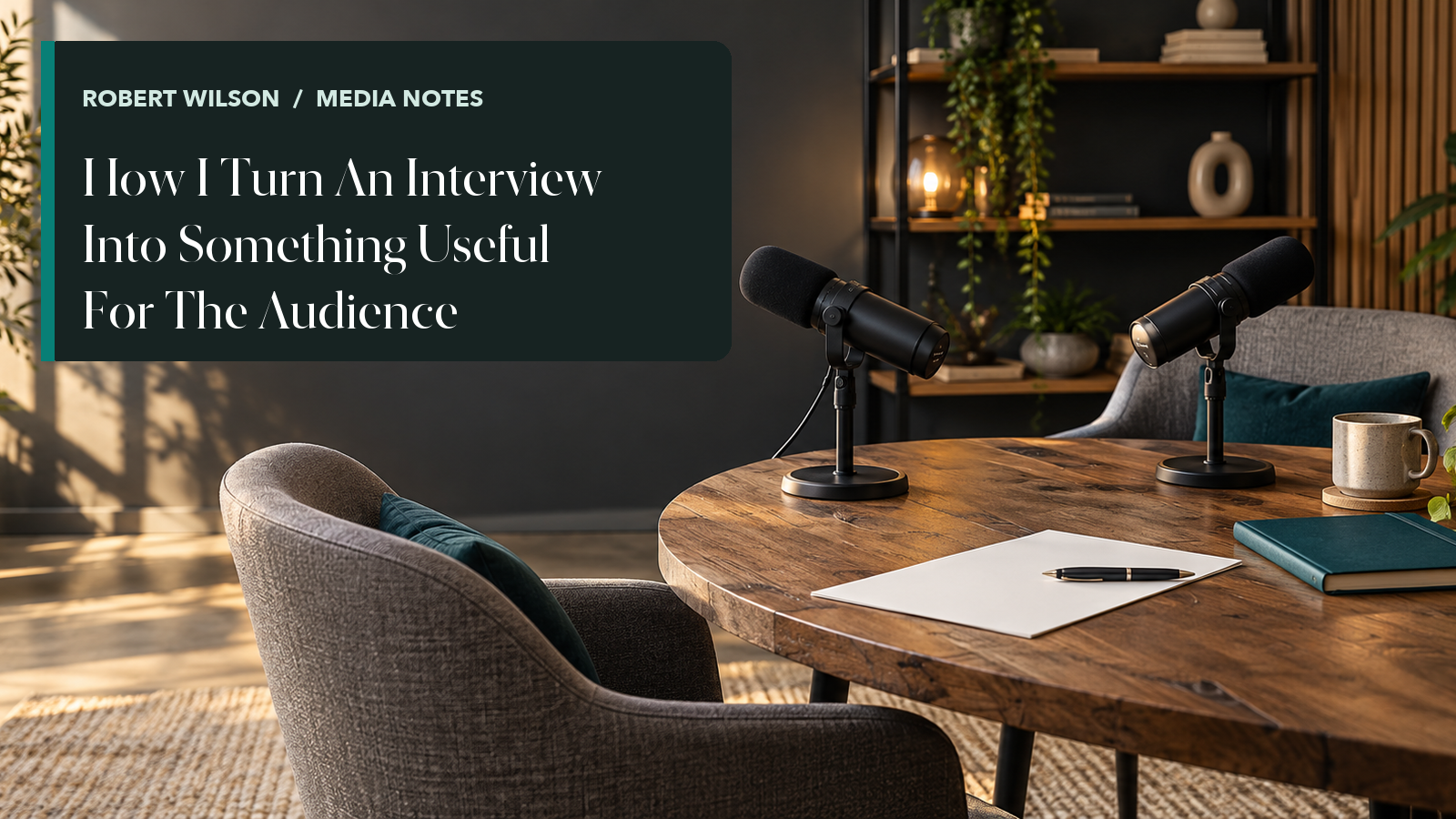
An illustrative recording space, not an actual Robert Wilson interview.
1. What Is The Audience Trying To Figure Out?
I start with a question a listener might actually have. “Tell us about your career” may be a warm opening, but it does not tell me what the audience will take away. “How did you decide which service problem to fix first?” gives the conversation a direction.
Write the audience question in one sentence. If the topic is broad, narrow it to a decision, an obstacle or a change the listener is facing. That sentence helps me select the guest, prepare the opening and cut material that does not serve the piece.
2. Why Is This Guest The Right Person To Ask?
A title is a starting point. I look for what the person has actually seen, built, changed or had to choose between. Someone who ran a process through a difficult handoff can explain the handoff. Someone who studied the problem from outside may bring a different, equally useful view. The distinction shapes the questions.
I also decide what I should not ask the guest to speak for. An interview with a leader does not automatically make that person an authority on every part of a company, an industry or a customer’s experience.
3. Which Example Will Make The Answer Concrete?
The first answer is often a principle. The follow-up is where the audience can see how it works: “Can you walk me through one decision?” “What information did you have at that point?” “What changed after you learned more?”
Those are prompts, not lines to force into every interview. A guest may have an example they can discuss publicly, or they may need to keep a client or colleague private. I can ask for an anonymized situation, a common pattern or a hypothetical instead, and label it accurately in the final story.
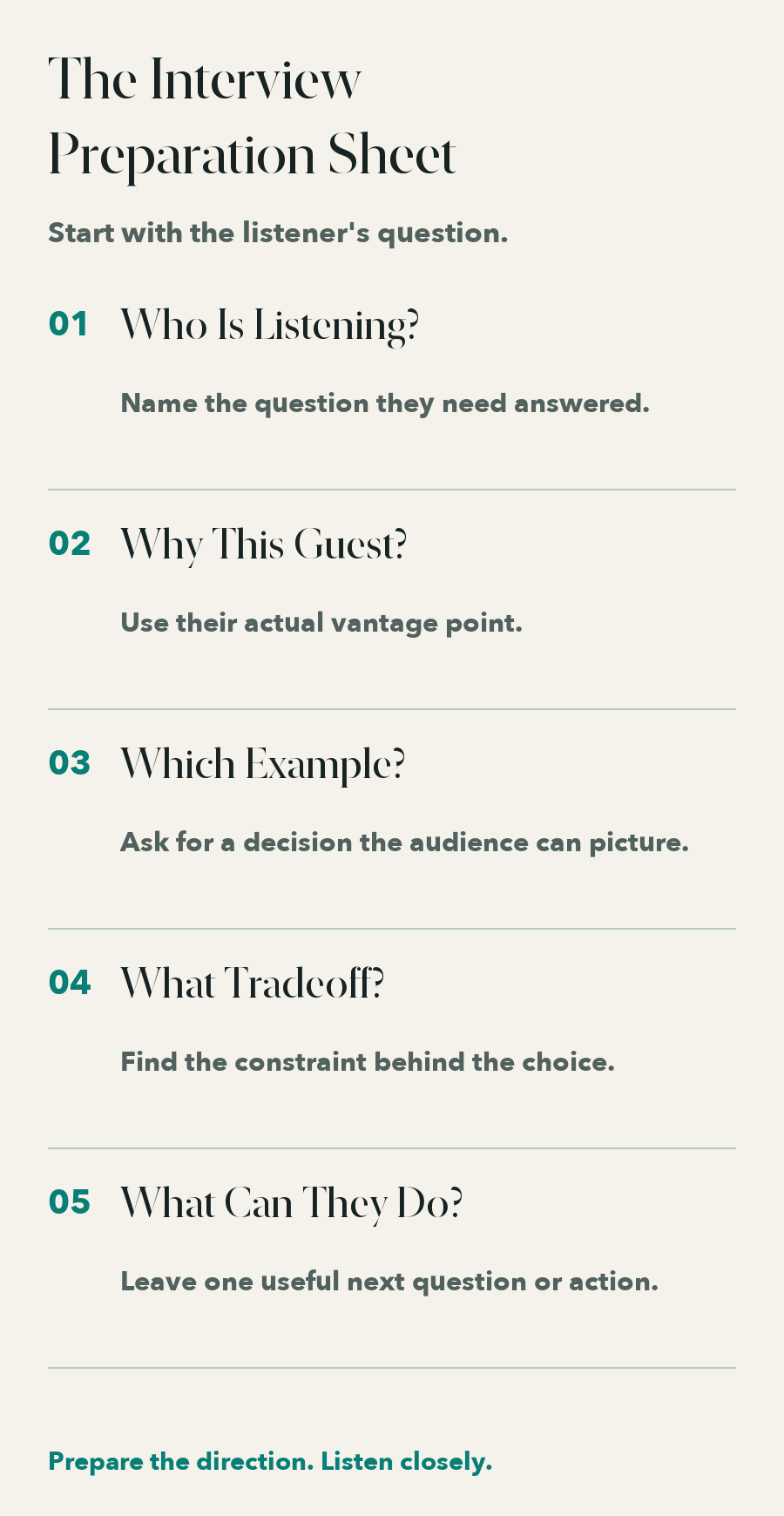
The five prompts keep preparation focused on the listener, the guest’s vantage point and an example the audience can understand.
4. Where Is The Real Tradeoff?
Good decisions usually have a cost or a constraint. If every option sounds easy, the conversation probably has not reached the interesting part. I might ask what the team gave up, which assumption proved wrong, or what they would handle differently with the same information today.
This is not a hunt for a dramatic confession. A useful tradeoff could be as ordinary as choosing a slower rollout so people can learn the process, or delaying a launch until the handoff is clear. The audience needs the reason, not a manufactured conflict.
5. What Can The Listener Do With This?
Before recording, I write the action or question I hope the listener will leave with. Sometimes the answer is a checklist. Sometimes it is a better question to bring into a meeting. If I cannot describe that takeaway, I need to sharpen the angle.
The close should come from the conversation that actually happened. I would rather summarize a practical point the guest supported than attach a neat lesson the recording did not earn.
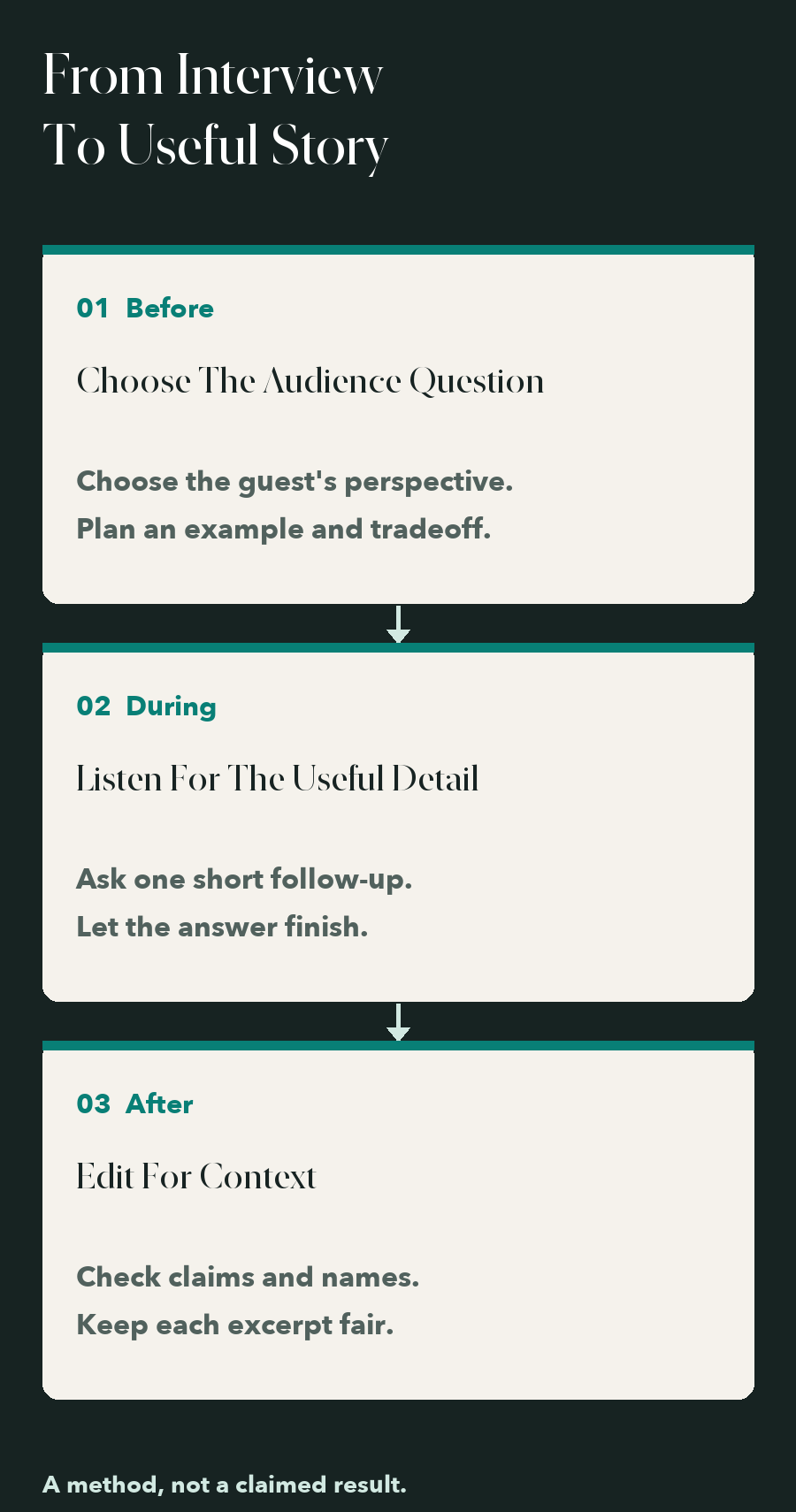
A useful interview is shaped before recording, improved by follow-up questions during the conversation and checked for context in the edit.
The Questions Are A Guide, Not A Script
Once recording starts, I need to listen. A prepared question may become irrelevant when the guest gives a better opening. That is when I ask the short follow-up and let the answer breathe. Afterward, I check names, claims and context before pulling a quote or turning an answer into a graphic. A short clip can travel farther than the full interview, so it should still represent the speaker fairly.
The test is simple: can someone who was not in the room explain the decision, the example and why it matters? That is the kind of interview I want to make.
What question has helped you get past a polished answer and into the useful part of a conversation?