
How I Change A Business Story For The Website, The Sales Conversation And The CIM
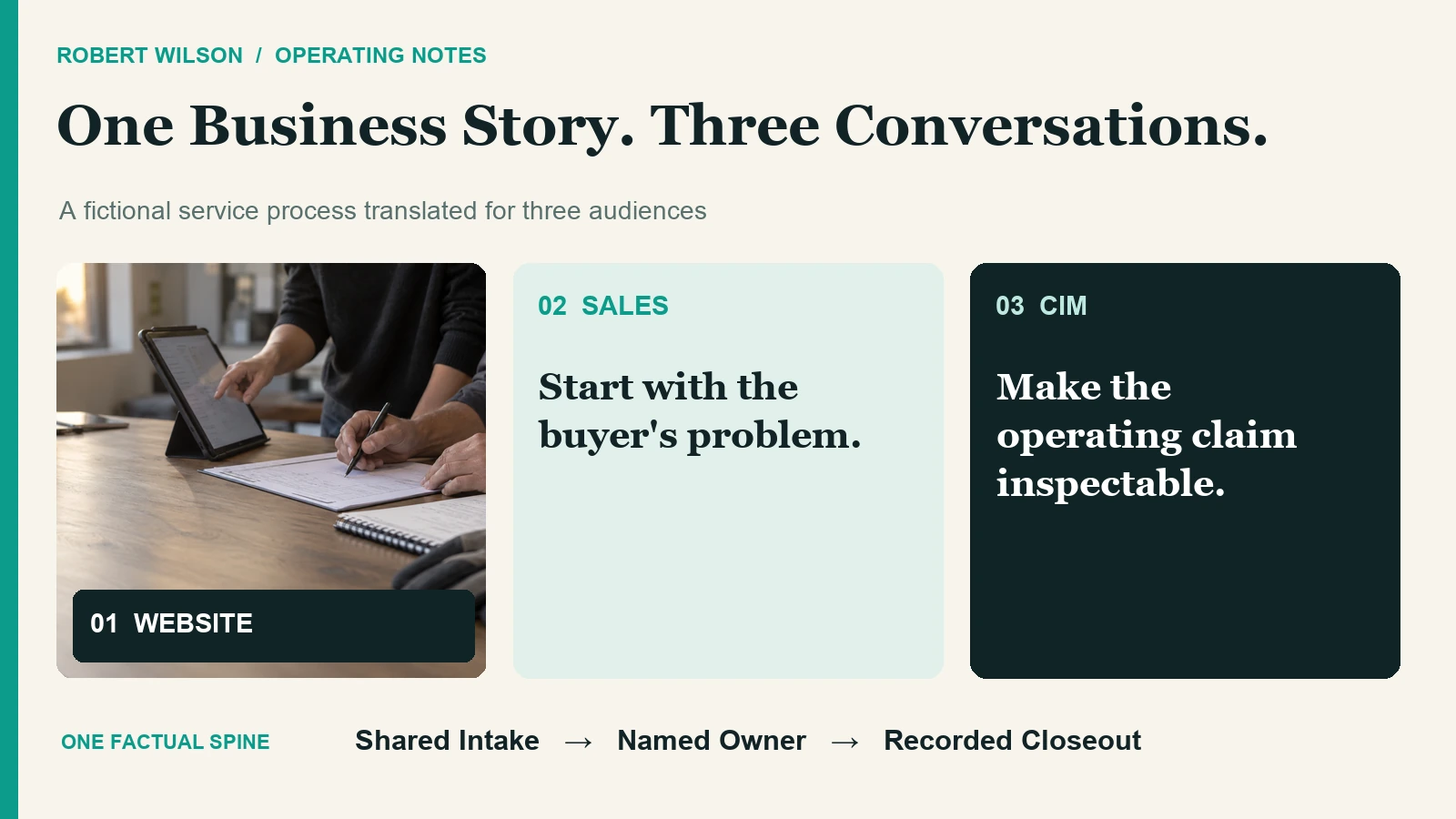
A company may describe the same service in three places and sound like three different businesses.
The website promises a smooth experience. The salesperson describes a custom process. The buyer-facing presentation lists operational steps. Each piece may have been written for a good reason, but a reader should be able to trace them back to the same facts.
I work across marketing, sales material and Confidential Information Memoranda, or CIMs. The format changes. The underlying business should not. My starting question is: What can we say consistently, and what does this particular audience need to understand about it?
The company and examples below are fictional. They show a writing method, not a client case, a live system or a measured result.
Write The Factual Spine First
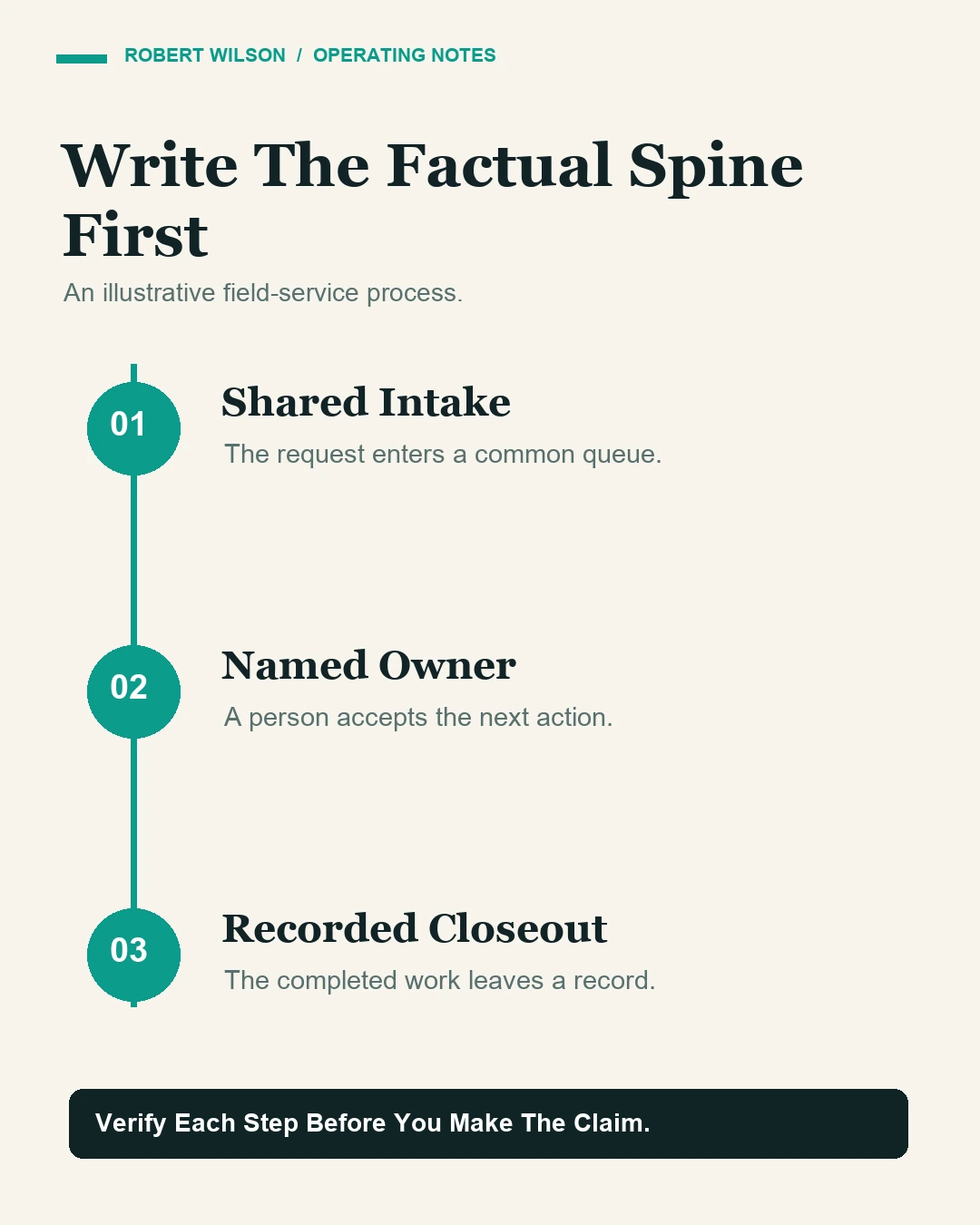
Imagine a field-service company with a documented process: requests enter a shared intake queue, each request is assigned to a named owner, and completed work receives a closeout record. For this exercise, those three steps are the verified facts. We have not established response times, conversion rates, customer satisfaction or any revenue effect.
I would put the factual spine on one line before writing a headline:
Shared intake → named owner → recorded closeout.
The arrows here mean actual transfers in the fictional process. The request enters a queue, responsibility moves to a person, and the completed work is recorded. If the real company cannot show one of those steps, it should not appear as a present-tense capability in any of the three formats.
That short line is not the final copy. It is a check against drifting into three separate promises.
On The Website, Answer The Customer’s Immediate Question
The website visitor is likely asking, “Can this business help me, and what happens if I contact them?” They do not need an internal process diagram before they understand the service.
For our fictional company, the website might lead with: “A Named Owner For Your Service Request.” A short paragraph can explain that requests are logged, assigned and followed through to closeout. The page should say what kind of requests the business handles, how to start and what the next step is. A relevant photograph or simple three-step illustration can make the service feel tangible.
That is a customer-facing translation of the same three facts. It does not turn the process into an unsupported claim that the company is the fastest or that every job goes perfectly.
In A Sales Conversation, Start With The Buyer’s Situation
The salesperson should not recite the website. They should learn where the buyer’s current process hurts.
Suppose a prospect says, “Requests disappear between the first call and the field team.” The useful response is specific: “Let me show you how requests enter our queue, who receives the assignment, and what gets recorded when the work is complete. Then we can compare that with the handoff you need.”
The same factual spine is present, but the order has changed. The buyer’s problem leads. The process is proof for a relevant answer, not a memorized pitch. If the company lacks a report or sample showing the handoff, the salesperson should say what can be shown rather than invent a dashboard.

In The CIM, Make The Operating Claim Inspectable
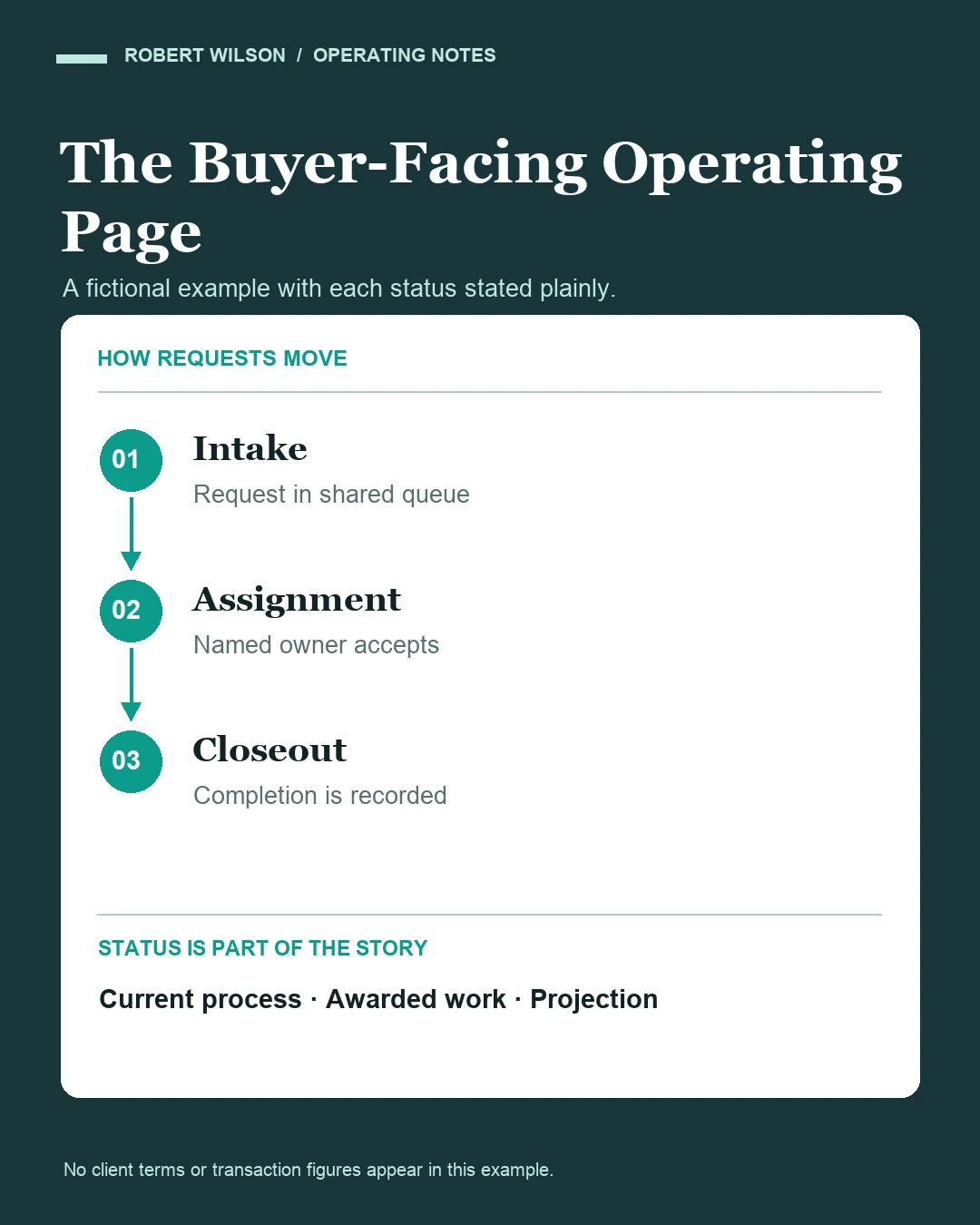
A buyer-facing CIM has a different job. It should help a reader understand how the business operates and what supports its claims. The sentence “We provide responsive service” is not enough to explain the intake model. A page could instead show the request path, the accountable role at each step, and what system or document records completion.
The CIM may also discuss customer mix, awarded work, open bids, historical results and a forecast. Those categories must stay distinct. A bid is not awarded work. A projection is not a completed result. The fact that a process is designed is not proof it is deployed across every team.
In recent buyer-facing presentation work, separating current work from possible future work made the story more accurate and easier to follow. That is a principle I would carry into any CIM. The private deal details do not belong in this example; the editorial lesson does.
Check The Three Versions Side By Side
Before any of the pieces goes out, I would put them next to each other and ask four questions:
| Check | Website | Sales Conversation | CIM |
|---|---|---|---|
| Audience question | Can you help me, and what happens next? | Can you solve the problem I described? | How does the business actually operate? |
| Same factual spine | Shared intake, owner, closeout | Shared intake, owner, closeout | Shared intake, owner, closeout |
| Best proof | Clear service path and next action | Walkthrough tied to the prospect’s case | Process, role and record evidence |
| Claim to avoid | Unsupported universal promise | Improvised feature or result | Treating a bid or projection as an actual result |
Each channel can use different language to answer its reader’s question while keeping the facts consistent.
The most useful review is often a spoken one. Ask someone who knows the operation to read the website claim aloud. Ask a salesperson whether they could demonstrate it. Ask the person preparing the CIM whether its status and evidence are accurately labeled. If one of them hesitates, improve the factual spine before polishing the headline.
A good business story travels. It can become more specific for a customer, more conversational with a prospect and more inspectable for a buyer. It should not become a different business each time it changes format.
If you are aligning a company’s website, sales materials and buyer-facing story, let’s talk.